Building a custom home can be exciting, but not knowing what will happen to your…
Conventional vs. Jumbo Loans: Which Fits a Luxury Home Purchase in San Antonio?
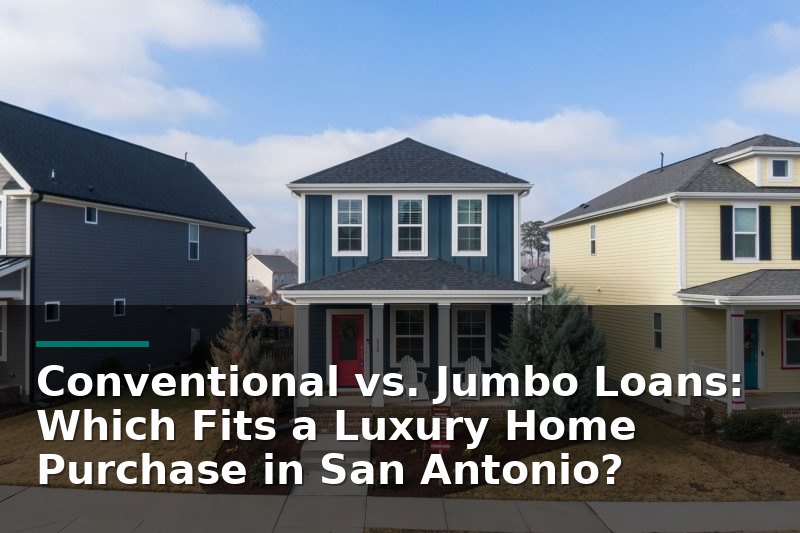
Buying a higher-priced home in San Antonio can be exciting, but choosing between conventional and jumbo financing can get confusing quickly.
A conventional conforming loan stays within current county loan limits, while a jumbo loan finances an amount above those limits and commonly requires stronger credit, more financial reserves, and additional documentation.
In this guide, we’ll explain how these loans differ, what lenders review, and how to decide which structure may fit your luxury home purchase.
Key Takeaways
- Loan Size: Conventional conforming loans must remain within current county loan limits, while jumbo loans exceed those limits.
- Qualification: Jumbo financing often requires stronger credit, lower debt relative to income, and more post-closing reserves.
- Down Payment: Both options depend on the borrower, property, and lender, but jumbo loans commonly require more equity.
- Property Review: Luxury, custom, and unique properties may receive additional appraisal scrutiny regardless of loan type.
- Best Fit: The right structure depends on the final loan amount, available assets, monthly payment, and long-term financial plans.
At H & M Mortgage Group, LLC (NMLS# 2597016), we help Texas homebuyers compare financing across more than 40 wholesale lenders rather than assuming one loan structure works for every purchase.
Quick Answers
- What is the main difference between conventional and jumbo loans? A conforming conventional loan falls within current county loan limits. A jumbo loan exceeds those limits and follows the individual lender’s jumbo guidelines.
- Does every luxury home require a jumbo loan? No. The home’s sales price does not determine the loan category by itself. The amount borrowed after the down payment is what matters.
- Can a larger down payment keep a loan within conforming limits? Yes. If the final loan amount is reduced enough to meet the applicable county limit, conforming financing may be possible.
- Are jumbo mortgage rates always higher? No. Jumbo and conventional pricing can move differently, and the result depends on credit, assets, property type, occupancy, and current market rates.
John bought his first home shortly after turning 24 and saw firsthand how responsible homeownership could affect a family’s financial future. That experience helped shape his work in mortgage lending beginning in 1998…with a focus on education, transparency, and real options.
What Is a Conventional Conforming Loan?
A conventional conforming loan is a mortgage that is not insured by a government agency and meets the loan limits and guidelines used by Fannie Mae or Freddie Mac.
People often shorten that term to “conventional loan.” Technically, conventional financing can include nonconforming loans too. But in a conventional vs. jumbo comparison, “conventional” usually means conforming.
Conforming loan limits vary by county and are updated periodically. A purchase in Bexar County may have a different applicable limit than a property in another part of Texas, so the current limit should always be verified before building a financing plan.
Conforming loans may offer:
- Standardized underwriting guidelines
- Down payment options that may begin as low as 3% for eligible borrowers
- Private mortgage insurance when required based on the loan structure
- More consistent documentation standards across lenders
- A broad secondary market for fixed-rate and adjustable-rate loans
That doesn’t mean conforming approval is automatic. Income, credit, assets, debts, property condition, appraisal results, and occupancy still matter.
What Is a Jumbo Loan?
A jumbo loan is a conventional mortgage with a loan amount above the conforming limit for the property’s county and unit count.
Because jumbo loans are not purchased under the standard conforming framework, lenders and investors set their own requirements. One jumbo program may accept a scenario that another does not.
Here’s what most people don’t realize…there isn’t one universal set of jumbo guidelines.
A lender may have its own rules for:
- Minimum credit history
- Debt-to-income ratios
- Down payment and equity
- Post-closing financial reserves
- Eligible property types
- Self-employment documentation
- Appraisal requirements
- How large deposits or transferred assets are documented
These lender-specific requirements are often called overlays. They matter because a borrower can meet broad jumbo standards but still fall outside one lender’s particular program.
Our jumbo home loan overview explains the broader program for buyers considering higher loan amounts in San Antonio and across Texas.
Conventional vs. Jumbo Loans at a Glance
| Feature | Conventional Conforming | Jumbo |
|---|---|---|
| Loan amount | Within the current county conforming limit | Above the current county conforming limit |
| Guidelines | Generally follows Fannie Mae or Freddie Mac standards | Varies by lender and investor |
| Down payment | May allow lower minimums for eligible borrowers | Often requires more equity, depending on the program |
| Reserves | Requirements vary by automated underwriting findings | More substantial reserves are commonly required |
| Appraisal | Typically one appraisal, subject to loan findings | May require added review or another valuation |
| Underwriting | More standardized | Often more detailed and lender-specific |
Guidelines, pricing, loan limits, and documentation requirements can change. Current information should be verified for the borrower, property, and lender being considered.
Why the Sales Price Doesn’t Decide the Loan Type
A luxury home does not have one official mortgage definition. A property can be considered luxury based on its location, design, acreage, finishes, or sales price, but that label does not automatically make the mortgage jumbo.
For example, a buyer may purchase a higher-priced home and make a larger down payment that brings the loan within the conforming limit. Another buyer could purchase a less expensive property with a smaller down payment and need jumbo financing because the amount borrowed exceeds that limit.
The loan amount after the down payment determines whether financing is conforming or jumbo.
This can matter for purchases in areas such as Alamo Heights, Stone Oak, The Dominion, Boerne, Fair Oaks Ranch, and other parts of Greater San Antonio and the Texas Hill Country where property prices and features can vary considerably.
How Jumbo Underwriting Is Different
Financial Reserves Receive More Attention
Jumbo lenders commonly want borrowers to retain funds after closing. These are called reserves and are often measured in months of housing payments.
Eligible reserve assets vary. Checking, savings, brokerage, and certain retirement assets may be considered, but lenders may discount some account values or restrict which funds qualify.
Why does this matter? A buyer may have enough cash for the down payment and closing costs but still need additional verified assets after closing.
Income Documentation May Be More Detailed
Salaried borrowers may need recent income documents and a clear employment history. Borrowers with bonuses, commissions, stock compensation, multiple businesses, rental properties, or other variable income can expect a closer review.
Self-employed borrowers are commonly asked for personal and business tax returns, year-to-date financial statements, and supporting business documents. Requirements vary by lender and by how the income is earned.
Unique Properties Can Require More Appraisal Work
Luxury and custom homes may have fewer comparable sales nearby. Acreage, guest structures, specialized construction, extensive renovations, or unusual design features can make valuation more involved.
A jumbo lender may request an appraisal review or additional valuation, especially at higher loan amounts. That does not mean there is a problem with the property. It means the lender wants stronger support for the value being used.
It’s Not Just About the Interest Rate…
A lower quoted rate does not automatically mean a loan has the lower overall cost.
Buyers should compare:
- Interest rate and annual percentage rate
- Discount points and lender charges
- Required down payment
- Mortgage insurance, if applicable
- Reserve requirements
- Fixed-rate versus adjustable-rate terms
- Prepayment restrictions, if any
- Total cash needed to close
And quite frankly…preserving liquidity may be more important to one buyer than reducing the loan amount as much as possible. Another buyer may prefer a larger down payment to reduce the monthly obligation.
Neither approach is automatically right. The financing should support the buyer’s broader financial plan without relying on uncertain future appreciation or refinancing.
Special Considerations for Custom and Move-Up Purchases
Some San Antonio luxury purchases involve a completed home. Others involve a custom build, a major renovation, or a purchase that must close before the current home is sold.
Those situations may require a different structure:
- Custom construction: An interim construction or construction-to-permanent loan may finance the build before permanent financing begins.
- Buying before selling: A bridge home loan may help qualified borrowers use available equity while transitioning between properties.
- Major renovations: Renovation financing may combine eligible acquisition and improvement costs, subject to program requirements.
Construction and bridge financing involve separate risks, timelines, costs, and underwriting standards. They should be reviewed early, particularly when contracts include builder deadlines or a sale contingency.
How to Decide Which Loan Fits
Here’s the thing…the decision usually becomes clearer once the full financial picture is reviewed.
- Confirm the current conforming limit. Use the limit that applies to the property’s county and unit count.
- Calculate the expected loan amount. Subtract the planned down payment from the purchase price, then account for any financed costs permitted by the program.
- Review available liquidity. Separate funds needed for closing from funds that must remain as reserves.
- Compare multiple structures. Review conforming and jumbo scenarios where both are possible.
- Evaluate the complete cost. Consider payment, cash to close, mortgage insurance, points, reserves, and loan terms.
- Allow time for the property review. Unique and custom properties may need more appraisal work.
My advice? Start pre-approval planning before writing an offer, especially when the purchase involves a jumbo loan, custom property, or complicated income.
We invite you to call, text, or email us to review your scenario, compare available options, and understand the next steps. No hype…No scare tactics…Just honest conversations and education.
Frequently Asked Questions
Will a jumbo loan require two appraisals?
Not always. Some lenders may require a second appraisal or additional valuation review based on the loan amount, property, or underwriting findings, while others may accept one appraisal.
Can a self-employed buyer qualify for a jumbo mortgage?
Potentially, yes. Jumbo lenders commonly review tax returns, business income, liquidity, and the stability of the business, but documentation and income calculations vary by program.
Can gift funds be used for a luxury home purchase?
Some conventional and jumbo programs allow eligible gift funds, but the permitted source, required borrower contribution, and documentation can differ. The gift should be reviewed before funds are transferred.
Are jumbo loans available for condominiums?
Yes, some jumbo lenders finance eligible condominium properties. Both the borrower and the condominium project may need to meet lender requirements involving insurance, ownership, finances, and other project characteristics.
Do jumbo loans take longer to close than conventional loans?
They can, but the timeline varies. More detailed asset documentation, income analysis, appraisal review, or lender-specific conditions can add time, so early pre-approval planning is helpful.

About the Author
John Hudson
CEO & Co-Founder, Mortgage Broker at H & M Mortgage Group, LLC · NMLS #261659
John Hudson (NMLS #261659) is Co-Founder and CEO of H&M Mortgage Group, LLC (NMLS #2597016), an independent mortgage brokerage based in San Antonio and serving Texas. A mortgage professional since 1998, he focuses on VA, conventional and FHA loans, with additional experience in down payment assistance, jumbo and construction financing.
Specializes in: VA home loans; Conventional mortgages; FHA home loans
Licensed in: TX

Related Posts